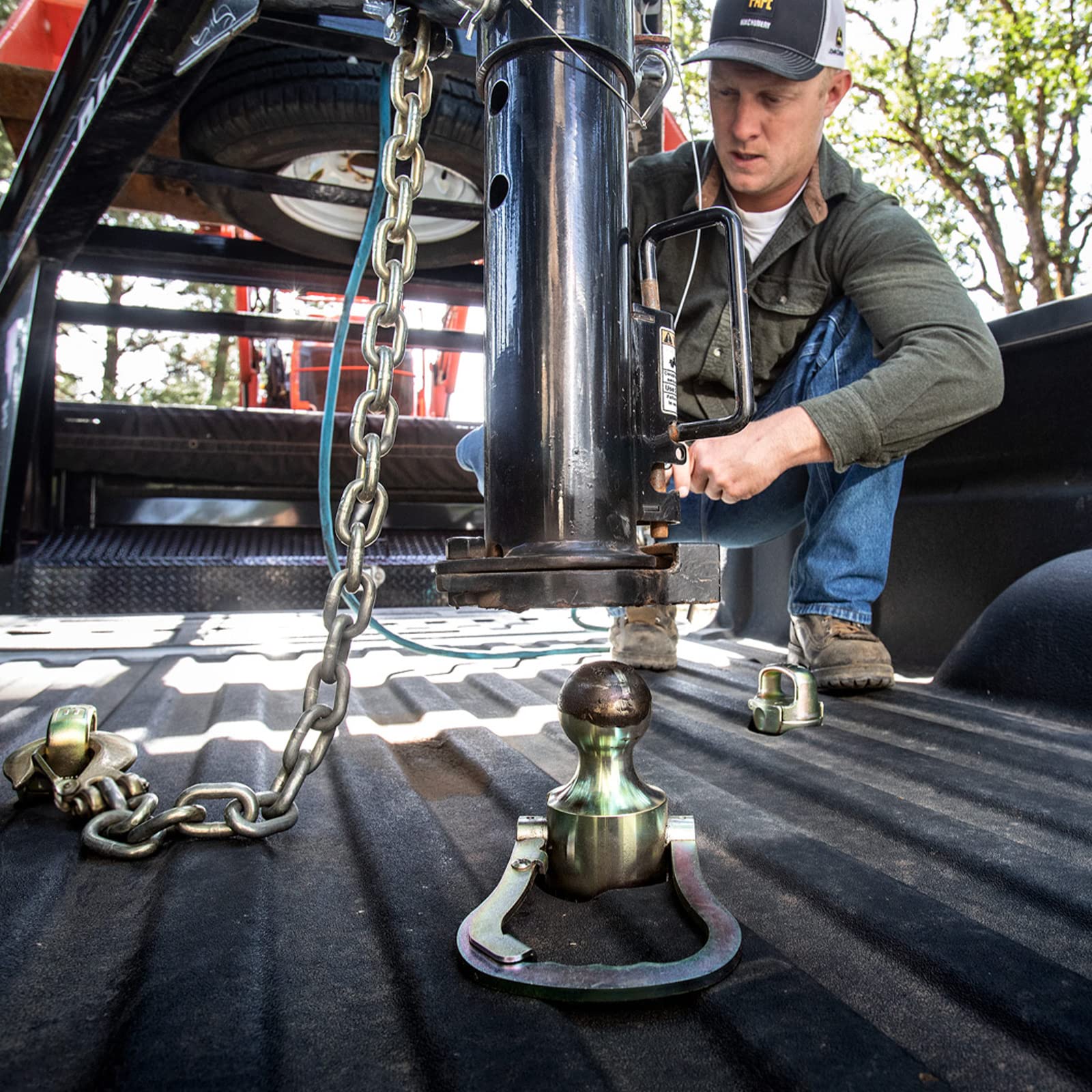
If you pull a stock trailer to the sale barn, a flatbed of equipment to a job site or a horse trailer to the Rodeo of the Ozarks, you already know why people swear by goosenecks. They turn tighter than a bumper pull. They handle more weight. And when you're done hauling, you pull the ball and get your truck bed back.
What people don't always think about is the install itself. A gooseneck puts thousands of pounds on one ball sitting in the middle of your bed. Whatever's holding that ball to the frame has to be done right, or the rating stamped on the box doesn't mean much.
The ball sits in the bed, a little ahead of the rear axle, and the trailer's coupler drops down over it. Because the weight lands near the middle of the truck instead of hanging off the bumper, the truck rides more level and the trailer follows better, especially in crosswinds and on curvy two-lane roads.
Most gooseneck hitches today mount under the bed. All you see is a small hole for the ball and two safety chain loops. On many designs the ball either pulls out or flips upside down into the hole, so you can haul feed, mulch or a load of lumber on a flat floor the rest of the week.
A lot of late-model Ford, Ram and GM heavy-duty trucks came from the factory with gooseneck prep. If yours has it, the install is mostly about adding the right ball, safety chain anchors and wiring, and it goes fairly quickly.
If your truck doesn't have factory prep, we install an aftermarket under-bed system. That means cutting a hole in the bed and bolting a crossmember assembly to the frame rails. This is the part you don't want rushed. Under that bed you'll find the fuel filler neck, brake lines, wiring, the exhaust and sometimes the spare tire. The hole has to line up correctly with the rear axle and still miss everything underneath it. If it's a couple of inches off, you either hit something you shouldn't or end up with a trailer that never sits right.
So we measure, check the hitch manufacturer's instructions, look under the truck, and measure again. It takes a little longer. It's also why the hitch ends up where it belongs.
Gooseneck hitches are commonly rated for 25,000 to 30,000 pounds or more, and it's easy to see that number and assume you're covered. You're probably not, at least not by the hitch alone.
The hitch is one link. Your truck's towing capacity, rear axle rating and payload all matter too, and the lowest number is the one you live with. A gooseneck trailer usually puts around 20 to 25 percent of its weight on the ball. On a loaded 20,000-pound stock trailer, that can be 4,000 pounds or more pressing down on your truck. Plenty of three-quarter-ton pickups don't have that much payload to give.
Before we drill anything, we'll look at your truck and the trailer you're planning to pull. If the numbers don't add up, we'll tell you then, not after the work is done.
Every gooseneck setup needs safety chain anchors in the bed, and they should tie into the hitch structure itself, not just bolt through the sheet metal. We also install a 7-way connector, either in the bed near the ball or at the rear bumper, so your trailer lights and brakes work the way they should.
If your trailer has electric brakes, and most heavy goosenecks do, you need a brake controller that's installed and set up for that load. On a downhill stretch of Highway 412 with a full trailer behind you, that controller does a lot of your stopping.
A shop that does this work every week will have quick, specific answers. If you get a lot of "it should be fine," keep looking.
Towing heavy around here means hills, narrow county roads and a lot of traffic that doesn't always give a trailer room. Between hay season, cattle hauling, the construction going on across Benton and Washington counties and weekend trips to horse shows, gooseneck trailers stay busy in this part of the state. A hitch that's installed correctly is one less thing to worry about with that much weight behind you.
How long does a gooseneck hitch installation take? Trucks with factory prep usually take a few hours. Aftermarket under-bed installs take longer because of the drilling and frame work.
Will a gooseneck hitch take away my truck bed? No. On most under-bed systems, the ball removes or flips over, leaving a nearly flat bed when you aren't towing.
Can I pull a fifth wheel trailer with a gooseneck hitch? Sometimes, with an adapter. Check with both your trailer and hitch manufacturers first, since some adapters affect ratings or warranties.
Do you offer gooseneck hitch installation near me? Long's Northwest Hitch installs gooseneck hitches for farmers, contractors, horse owners and RVers in Bentonville, Rogers, Springdale, Fayetteville, Siloam Springs, Gentry, Farmington and surrounding Northwest Arkansas communities.
If you're adding a gooseneck to a new truck or replacing an old hitch that's seen better days, give us a call.