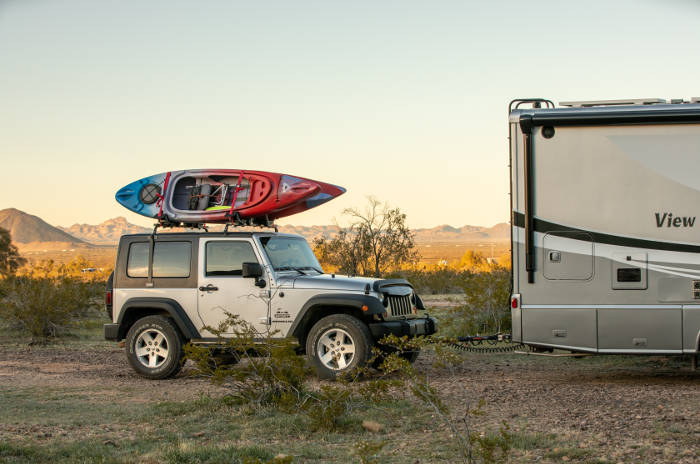
Your motorhome is magnificent. It has a king bed, two slide-outs, a residential fridge and more square footage than your first apartment. What it does not have is any business squeezing into a parking spot at the Bentonville Square or climbing a gravel road to a Buffalo River trailhead.
At some point every seasoned RVer realizes the same thing: nobody wants to unhook the water, pull in the slides and drive a 30,000-pound coach to the grocery store because someone forgot the marshmallows. That's when the Jeep starts looking less like a vehicle and more like a lifeline.
Welcome to dinghy towing. Done right, it's one of the best upgrades you'll ever make to your RV life. Done wrong, it can damage two very expensive vehicles at once. Here's what a dinghy towing system does and how a professional installation keeps it safe.
Dinghy towing, also called flat towing or four-down towing, means pulling a car, Jeep or small SUV behind your motorhome with all four of its wheels on the road. The towed vehicle, often called a "toad" or "dinghy," follows the coach like a boat behind a yacht, which is where the name comes from.
Unlike a tow dolly or a car trailer, a dinghy system has nothing to store at the campground, nothing to load and unload, and very little to wrestle with in a tight site. You pull in, unhook in a few minutes and drive off to explore.
A complete dinghy towing setup has several parts that have to work together:
Miss any one of those, and you don't have a dinghy system. You have a very nice car being dragged down the highway.
Not every vehicle can be towed four-down. Many Jeep Wranglers and Gladiators, Ford Broncos and certain trucks and SUVs are popular dinghy vehicles because their transfer cases can be shifted into neutral. Many other cars can't be flat towed at all without damaging the transmission, or need add-ons like a driveshaft disconnect or a transmission lube pump.
The only reliable answer is in your owner's manual, usually under "recreational towing" or "towing your vehicle behind a motorhome." A good installer will check it with you before recommending anything. If your vehicle isn't flat-towable, they'll tell you, and save you from learning it the expensive way.
Here's the insight even longtime motorhome owners sometimes skip: your coach's brakes were designed to stop your coach. Add a 4,000- to 5,000-pound Jeep behind it and your stopping distance grows, your brakes run hotter and your margin for error on a downhill grade shrinks fast.
A supplemental braking system fixes that by braking the toad in sync with the motorhome. Many states require braking on towed vehicles above certain weights, and rules vary from state to state, so a system that keeps you legal in Arkansas also needs to keep you legal wherever you're headed. More importantly, it keeps you in control on the long Ozark descents of I-49, Highway 71 and Highway 23.
A professional dinghy towing installation is a lot more than bolting on a tow bar. Here's how [Company Name] handles it:
Experienced RVers don't make beginner mistakes. They make experienced mistakes, usually when they're tired, rushed or being helped by a well-meaning brother-in-law:
A good installation and a thorough walkthrough make every one of these less likely.
You're connecting two vehicles that together may be worth more than your house. That's not the moment for guesswork. A certified installer is trained on current base plates, tow bars and braking systems. An experienced one has already worked on vehicles like yours and knows where the surprises hide behind the bumper.
Before booking dinghy towing installation in Northwest Arkansas, ask:
Park the coach at Beaver Lake or near Eureka Springs, unhook the Jeep and head for the Buffalo National River, the Pig Trail or downtown Bentonville for dinner. That's the whole point of a dinghy towing system: the big rig stays put, and you get to go explore.
What does a dinghy towing system include? A base plate, tow bar, safety cables, towed vehicle wiring, a supplemental braking system and a breakaway system. Many setups also include a charge line or battery disconnect.
Do I need a supplemental braking system to flat tow? Many states require one above certain towed weights, and it's strongly recommended regardless. It shortens stopping distances and reduces strain on your motorhome's brakes.
How long does a dinghy towing installation take? It depends on the vehicle and the components. Base plate installs that require bumper removal take longer. Your installer can give you a timeline when they quote the job.
Do you install dinghy towing systems in Northwest Arkansas? Yes. Long's Northwest Hitch installs dinghy towing systems for motorhome owners in Bentonville, Rogers, Springdale, Fayetteville, Bella Vista, Siloam Springs and surrounding areas.
You've already mastered the coach. Let us handle the connection. Call us today for a quote on professional dinghy towing installation anywhere in Northwest Arkansas.