Most people who tow a travel trailer can tell you exactly where they were the first time it started to sway. Maybe a semi passed on I-49 near Lowell. Maybe a gust caught the trailer coming over a hill on Highway 412. Either way, the feeling sticks with you: the back of the truck gets light, the trailer starts moving on its own, and for a few seconds it seems like the trailer is driving and you're along for the ride.
Sway is one of the most common reasons people come to us after buying a camper. The good news is that most of it can be prevented with the right equipment, set up correctly for your truck and trailer.
Sway happens when something pushes the trailer sideways and it doesn't settle back in line behind the truck. A few things usually set it off:
Travel trailers catch more of this than most. They're tall and flat-sided, which makes them work a lot like a sail, and the hitch point sits well behind the truck's rear axle, giving the trailer plenty of leverage to push the truck around.
People use "anti-sway hitch" to mean a few different things, so it helps to sort them out.
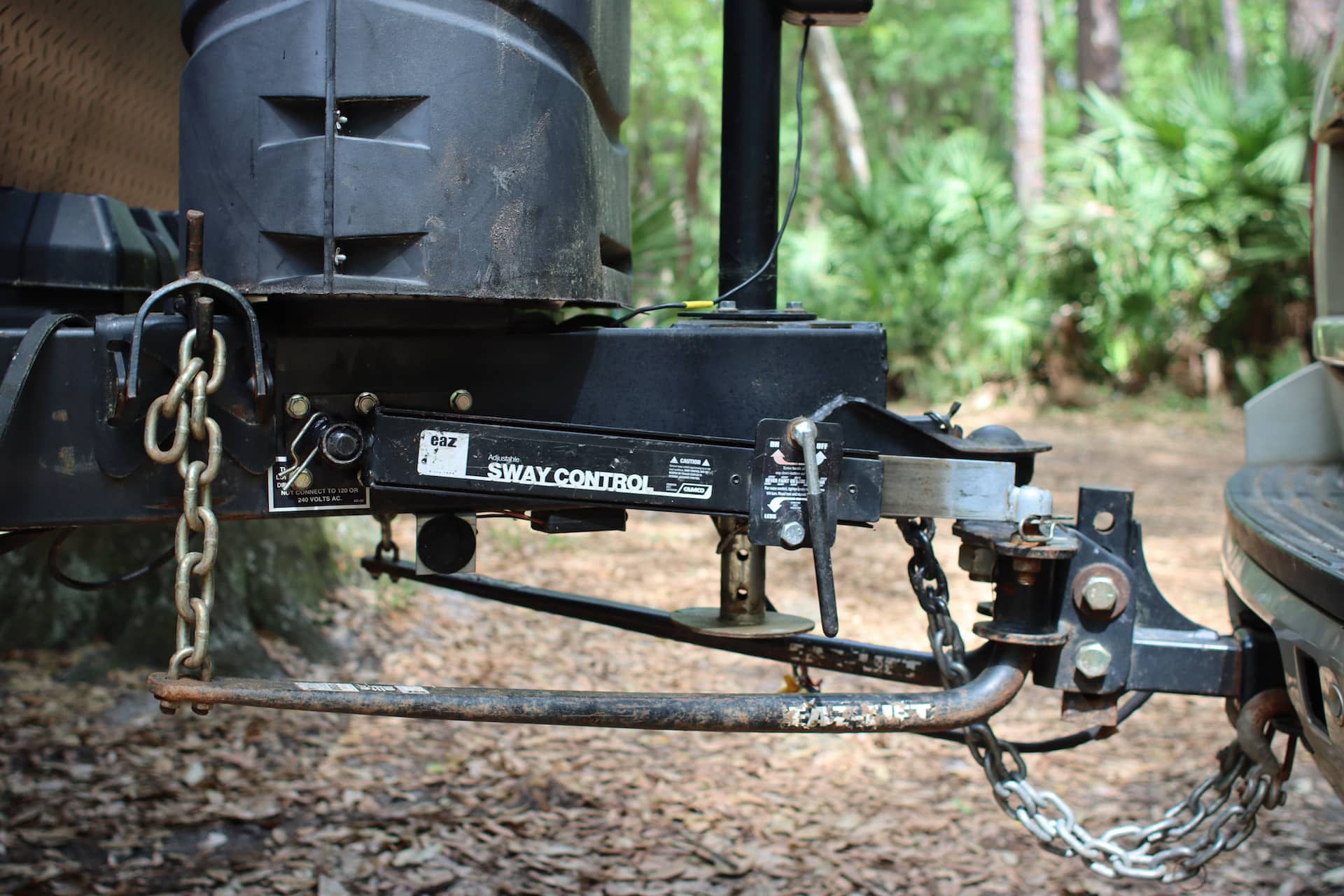
A weight distribution hitch uses spring bars to spread the trailer's tongue weight forward to the truck's front axle and back to the trailer's axles. Without it, a heavy tongue pushes down on the back of the truck and lifts the front, which takes weight off your steering tires right when you need them. With it, the truck rides level and steers the way it was designed to.
Sway control resists the trailer's side-to-side movement. Some systems use friction, some use cams, and some build the sway control into the weight distribution head itself. There are also more advanced designs that change the hitch geometry so the trailer tracks almost like it's on rails. Those cost more, but some owners of larger travel trailers say they wouldn't tow without one.
Many modern hitches handle both jobs in one unit. Which one makes sense for you depends on your trailer's weight and length, your truck, and how and where you tow.
We see this a lot: someone buys a quality weight distribution hitch, and the trailer still feels squirrelly. Usually the hitch was never set up for that truck and trailer. It came from the dealer with a ball height guess and spring bars tensioned "about right," or it was moved over from a previous trailer without being readjusted.
A weight distribution hitch has to be tuned. Ball height, head tilt and spring bar tension all affect how much weight goes back to the front axle and how level everything rides. If the setup is off, you can end up with too little weight on the front tires, too much stress on the hitch or a trailer that sits nose-high or nose-low. Any one of those can make sway worse instead of better.
If you change trucks or trailers later, the hitch should be set up again. A setup that was right for one combination is rarely right for another.
Even with good equipment, it pays to know what to do. Ease off the gas and keep the steering wheel as straight as you can. Don't slam on the truck's brakes or jerk the wheel to correct. If you have a brake controller, applying the trailer brakes alone with the manual lever can help pull the trailer back in line. Once things settle, pull over when it's safe and figure out what caused it, whether that's speed, loading or a setup problem.
Our roads give sway plenty of chances. The Boston Mountains stretch of I-49, the hills along Highway 412 and the open ridgelines around Beaver Lake all get gusty, and the I-49 corridor between Fayetteville and Bentonville carries a steady stream of trucks. A trailer that tows fine on a calm day in town can feel very different on a windy Saturday with a full load headed to the lake.
Do I need a weight distribution hitch for my travel trailer? If your tongue weight is a large share of your truck's hitch rating, or the truck squats noticeably when you hitch up, you probably do. Some vehicle manufacturers require weight distribution above certain trailer weights, so check your owner's manual.
Will an anti-sway hitch fix a badly loaded trailer? It helps, but it can't make up for poor loading. Keeping tongue weight around 10 to 15 percent of the trailer's weight and loading heavy items over or slightly ahead of the axles still matters.
My truck has trailer sway control built in. Do I still need a hitch with sway control? Built-in systems react after sway starts by applying brakes. Hitch-based sway control works to keep sway from starting. Many owners use both.
Do you install anti-sway hitches near me? Long's Northwest Hitch installs and sets up weight distribution and sway control hitches in Bentonville, Rogers, Springdale, Fayetteville, Bella Vista, Centerton, Lowell, Siloam Springs and surrounding Northwest Arkansas communities.
If your trailer has ever made you grip the wheel a little tighter, it doesn't have to stay that way. Reach out to Longs Northwest Hitch to get an anti-sway system installed and set up for your truck and trailer.